
 Register


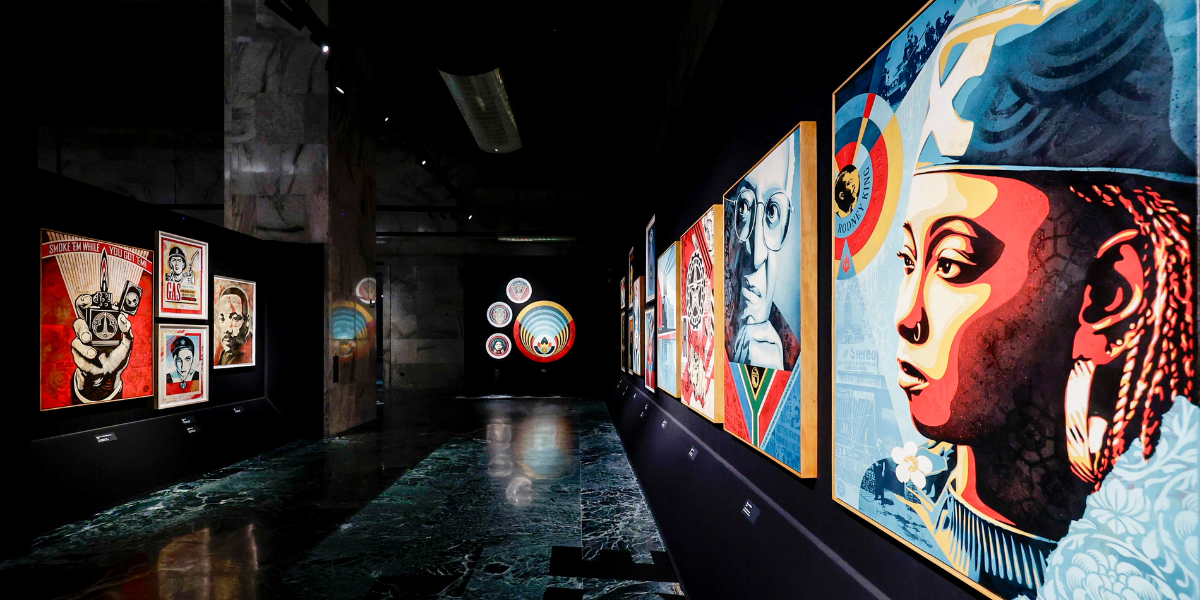
In OBEY: Power to the peaceful, on view at Gallerie d’Italia – Napoli until September 6, 2026, the work of Shepard Fairey, internationally known as Obey, unfolds as a visual reflection on the tensions of our time. The exhibition path explores some of the central themes of his research — from the power of communities to propaganda, from conflict to peace. “Giustizia Sociale”, one of the project’s thematic sections, represents a space in which the image becomes a critical tool, capable of questioning contemporary inequalities and the dynamics of exclusion that shape the present.
Obey’s language
Obey has always worked with the impact of public imagery. His visual vocabulary draws on political graphics, posters, urban culture, and the codes of propaganda, transforming them into an immediate and recognizable language. The strength of his works lies precisely in this ambivalence: using familiar forms, sometimes associated with power and consensus, to overturn their meaning and open up a space of awareness.
In this balance between accessibility and complexity, the image never remains a surface, but becomes a place of confrontation, a device for reading the present, an invitation to observe what often remains at the margins of the collective gaze.
Making exclusion visible
The “Giustizia Sociale” section takes shape around the inequalities and dynamics of exclusion that run through contemporary society. At its center are marginalized subjectivities and communities, presences often made invisible by dominant social, economic, and cultural systems.
The works give form to structural tensions, bringing to the surface those mechanisms of power that produce disparities and normalize their effects. In this context, the image becomes a form of emergence: it brings to light what tends to remain implicit, hidden, or absorbed by habit, returning it to the viewer as an open question.
A shared responsibility
The section does not end with denunciation. Rather, the recognition of injustice becomes the starting point for a broader, shared responsibility. Faced with the works, the viewer is not only invited to observe, but to take a position, to question their own role in relation to the fractures that mark the present.
Dignity, representation, and inclusion are thus redefined through a visual language that is direct, yet never univocal. The clarity of the image coexists with a layering of meanings that invites us to look deeper, beyond the immediacy of the sign.
Art as a space of claim-making
In “Giustizia Sociale”, art takes on an active function. It does not merely represent conditions of marginality or imbalance, but becomes a practice of claim-making, a construction of meaning, and a possibility for confrontation. The works open up a space in which equity does not appear as an abstract principle, but as a collective, fragile, and necessary process, constantly to be negotiated.
It is in this dimension that the section finds its strength: in the idea that the image can help imagine new forms of coexistence, founded on mutual recognition and on the ability to make visible what the present tends to exclude.
Beyond the gaze
With “Giustizia Sociale”, OBEY: Power to the peaceful invites us to pause on one of the deepest aspects of Shepard Fairey’s poetics: the possibility that the image may become an act of awareness. Not simple representation, but a critical gesture; not only communication, but the opening of a shared space.
In this section of the exhibition, social justice is not presented as a definitive answer, but as a collective question. A question that concerns the way we look, recognize, and inhabit the world together with others.