
 Register


For some artists, their place of origin does not remain in the background of their biography, but becomes central to their research. This happens when a visual language emerges from a specific landscape, from its material, its colours and the memory it carries. In these cases, separating the work from the territory would mean depriving it of an essential part of its meaning.
It is then that rootedness takes on a broader value: for the place from which it originates, for the institutions that help tell its story and for those organisations that choose to engage with authentic narratives, built over time rather than artificially constructed. The journey of Fabio Schirru, known as Tellas, offers a particularly clear example of this relationship.
A name that embodies a poetics
Born in Cagliari in 1985 and raised in Campidano, Tellas spent his childhood among the dry, stony fields of southern Sardinia, in a family of farmers.
The choice of his artistic name is already part of his imagery. The term “tellas”, which he encountered in Giovanni Lilliu’s book La civiltà dei sardi, refers to the discarded stones produced during the construction of nuraghi. Excluded, marginal fragments, apparently without value, which the artist instead chooses to adopt as a mark of identity.
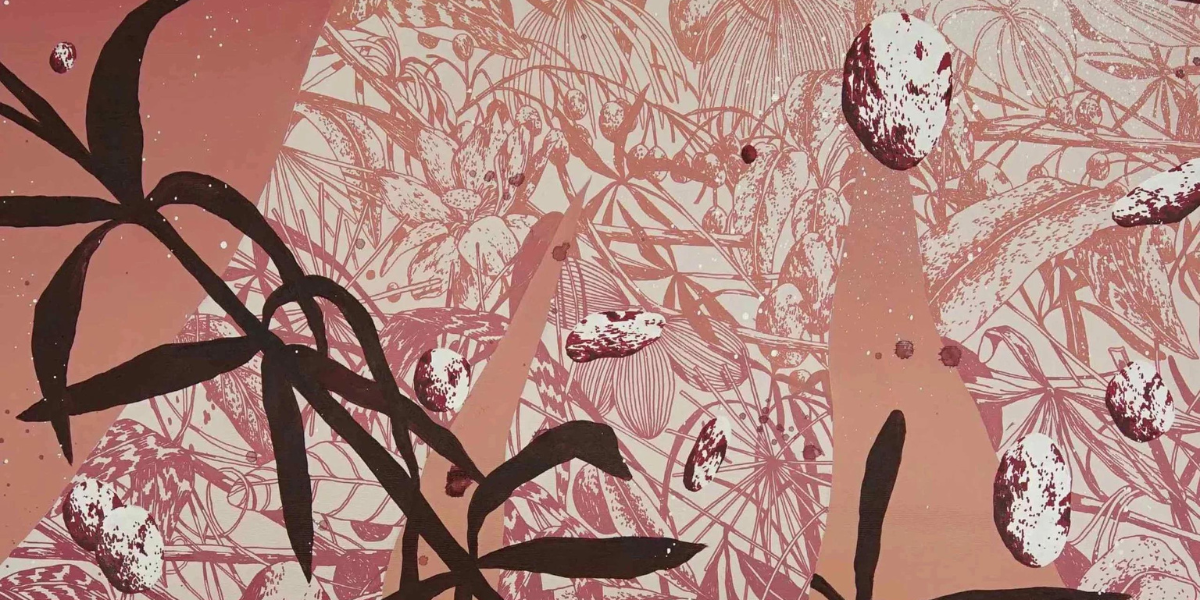
The colours that characterise his work also derive directly from this sense of belonging. Sand, ochre, muted greens and desaturated blues are not the result of a purely formal choice, but visually convey a landscape absorbed and sedimented over time. For those familiar with the Sardinian hinterland, these tones immediately recall the island’s soil, stones and vegetation.
The artwork as part of the place
Tellas’s work always begins with a direct encounter with space. Observation, drawing and listening to the context come before the intervention: elements that make his practice truly site-specific.
In Cagliari, during the year in which the city was Italian Capital of Culture, the work Under the City transferred the depths of the Santa Gilla lagoon onto the façade of a residential building on the outskirts. An intervention that clearly shows how an urban surface can take on a new meaning.
The wall is not simply enriched by an image. It becomes a landmark, an element capable of attracting attention and entering the neighbourhood’s collective narrative. In this way, the artwork helps strengthen the identity of the place and build a new form of shared cultural heritage.
Collaborations grounded in authenticity
The strength and recognisability of this research have also attracted the interest of several brands over time. Tellas has worked with Ferragamo and Marni. As part of his collaboration with Marni, he created murals and installations that were later included in the documentary A grande terra do Sertão, presented at the 56th Venice Biennale.
A different kind of collaboration was developed with Univer, part of PPG Architectural Coatings. In this case, the relationship goes beyond an association of image: the company supplied materials for regeneration projects, from the artist’s home-studio in Decimoputzu to the restoration of the Argentiera mining village through the MAR project.
This distinction is significant. When a company’s support makes a concrete contribution to transforming a space and returning it to the community, the collaboration moves beyond the logic of simple sponsorship and becomes an active part of the cultural process.
The value of an authentic connection
Tellas’s research also found a place in the eastern outskirts of Rome with E.P.ART, a project curated by Wunderkammern and included in Rome’s ROMARAMA programme. Here too, the intervention demonstrated how an artwork conceived in relation to its context can transform an urban wall into a new landmark for the neighbourhood.
A connection to a territory cannot be artificially constructed or replicated on demand. This is precisely what makes it so valuable. Engaging with Tellas’s work does not simply mean recognising its aesthetic qualities, but encountering a story that is already rooted, recognisable and deeply connected to a community.
It is a form of authenticity that does not arise from a communication strategy, but from a genuine journey. The most thoughtful collaborations, in this sense, do not seek visibility alone: they seek the opportunity to take part in a credible narrative, already connected to a place and its memory.
Trame d’Estate: a return to the land of origin
This relationship with Sardinia is also at the heart of Trame d’Estate, the project that Wunderkammern dedicates to Tellas at its Chia location. The exhibition brings together a selection of unique works, presented in a setting where the light of the coast, Mediterranean vegetation and the natural landscape enter into direct dialogue with the artist’s language.
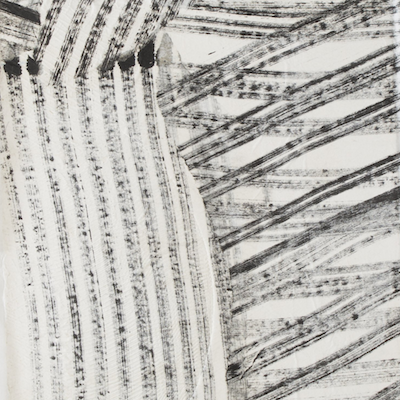
Signs, botanical forms, geometries and textures create a journey in which nature is never described literally. Instead, it is suggested through rhythms, layers and tones that transform earth, air and vegetation into visual matter.
The project thus becomes an opportunity to closely explore the relationship between landscape, memory and abstraction that runs through his entire body of work.
The exhibition is open until 2 August.