
 Register


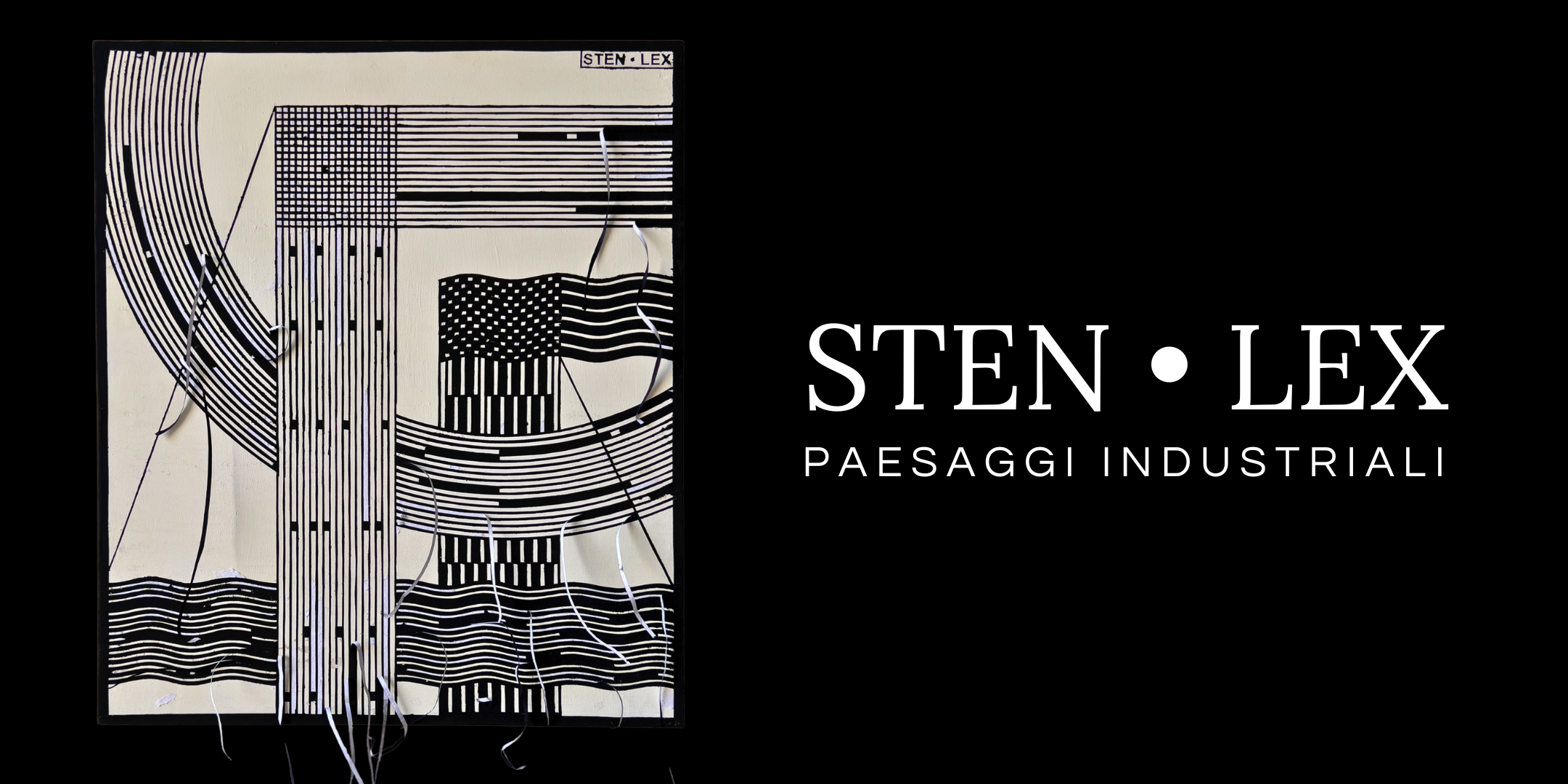
STEN LEX – Industrial Landscapes: the new exhibition at Wunderkammern Rome
From 15 October 2026, Wunderkammern presents Industrial Landscapes, the new solo exhibition by STEN LEX at its Rome gallery in Via Giulia 122. Curated by Marta Silvi, the project marks a new chapter in the research of the Italian duo, among the pioneers of urban stencil art, through a body of works exploring the relationship between image, matter, time and transformation. The artists will be present at the opening on 15 October.
STEN LEX return to Rome with Industrial Landscapes
Electricity pylons, gasometers, metal structures and wind turbines. With Industrial Landscapes, STEN LEX turn their attention to the architectures that have transformed the territory and shaped the visual language of modernity.
Elements connected to industry, energy and technological development become the protagonists of a new series of works in which present and future seem to overlap. The structures depicted appear at once as symbols of progress and as remnants of a possible archaeology of the future.
This represents a significant step in the evolution of STEN LEX’s artistic research. From their early black-and-white portraits, their visual language has gradually moved towards grids, lines, circles, maps and geometric structures. In Industrial Landscapes, the subject continues to transform, giving increasing space to technique, matter and process.
From stencil to an artwork in transformation
Since the beginning of their practice, STEN LEX have transformed stencil into a field of experimentation. In their work, the stencil matrix is not simply a tool used to reproduce an image, but becomes an integral part of the artwork itself.
It is cut, applied to the surface, painted and subsequently consumed or torn away. This process challenges one of the principles traditionally associated with stencil: the possibility of reproducing the same image multiple times.
In the works of STEN LEX, the opposite happens. The matrix is transformed and ultimately destroyed, making each work unique and unrepeatable.
As curator Marta Silvi writes in the text accompanying the exhibition:
“The artwork thus rejects the immobility of the finished object and takes the form of an event in continuous transformation.”
Time therefore does not simply act upon the artwork after its completion: it becomes part of the very process through which the work takes shape.
An exhibition unfolding across two levels
The installation of Industrial Landscapes is itself conceived to make this process of transformation visible.
The two levels of Wunderkammern’s Rome gallery become two different moments within the life of the same image. The works displayed on the upper floor and those installed in the underground spaces originate from the same compositions and grids, yet they are presented in two different states.
A true “Upside Down”, in which visitors encounter the same image at different stages of its existence, creating a dialogue between creation, transformation and sedimentation.
On the upper floor, the large-scale works physically retain the paper matrices used by the artists during the production process. Hand-cut and only partially attached to the surface, the paper strips remain free to move and react to the surrounding air and space.
The artwork is therefore never entirely complete: the paper continues to change, and with it, so does the perception of the image.
The “veil”: a new phase in STEN LEX’s research
In the lower spaces of the gallery, a new element enters the duo’s research: the “veil”.
A textile gauze, derived from traditional restoration techniques and the methods used to detach frescoes, covers the surface of the artwork and filters its visibility. While on the upper floor the image is exposed to movement and transformation, here it appears protected and suspended.
The veil therefore introduces a different relationship with time: the image appears preserved, almost crystallised within an undefined temporal dimension.
These two apparently opposite conditions belong to the same artistic investigation: change on one side, preservation on the other; matter transforming on one side, the attempt to retain it on the other.
Between control and chance
The tension between opposites has always been central to the work of STEN LEX.
The planning of the images and the manual cutting of the matrices require precision and control. Yet a moment arrives when the artists deliberately choose to relinquish that control: the matrix is torn, the paper breaks apart and the pigment introduces elements of unpredictability.
Construction is followed by destruction; precision by error; artistic intention by the intervention of matter and time.
The same tension runs through the subjects of the new series. Industrial architecture bears witness to humanity’s ability to reshape the landscape through technology, while also carrying the traces and consequences of that transformation.
As STEN LEX explain:
“The industrial landscape becomes a reflection of the tension between humanity’s desire to innovate and the fragility of the environment into which every innovation is introduced.”
In this sense, Industrial Landscapes is not simply a reflection on images. It is a reflection on transformation: of matter, of territory and of the very idea of progress.
STEN LEX: over twenty years of research into stencil art
STEN LEX began working together in Rome, where they created their first street stencil in 2001. Among the pioneers of Stencil Graffiti in Italy, over more than twenty years they have developed a distinctive visual language combining cutting, printing, painting and intervention in public space.
In 2008, they were invited by Banksy to the Cans Festival in London. In the following years, they created interventions and projects in cities including Rome, Paris, Madrid, New York, Shanghai, Bangkok, Austin, Monterrey and Mexico City.
Their research has also been presented in museums and international institutions including MACRO – Museo d’Arte Contemporanea di Roma, CAFA Art Museum in Beijing, MACO Museum in Oaxaca, Urban Nation in Berlin, GAM – Galleria d’Arte Moderna di Roma and Jupiter Museum of Art in Shenzhen. Their work Paesaggio Urbano XV has also entered the Farnesina Collection.
Industrial Landscapes also continues a long-standing collaboration with Wunderkammern, which began with the artists’ Rome solo exhibition in 2015 and continued in 2019 with Confini at the gallery’s Milan venue.
Exhibition information
STEN LEX – Industrial Landscapes
Curated by Marta Silvi
Opening: Thursday, 15 October 2026, with the artists in attendance
Wunderkammern Rome
Via Giulia 122, Rome