 Register


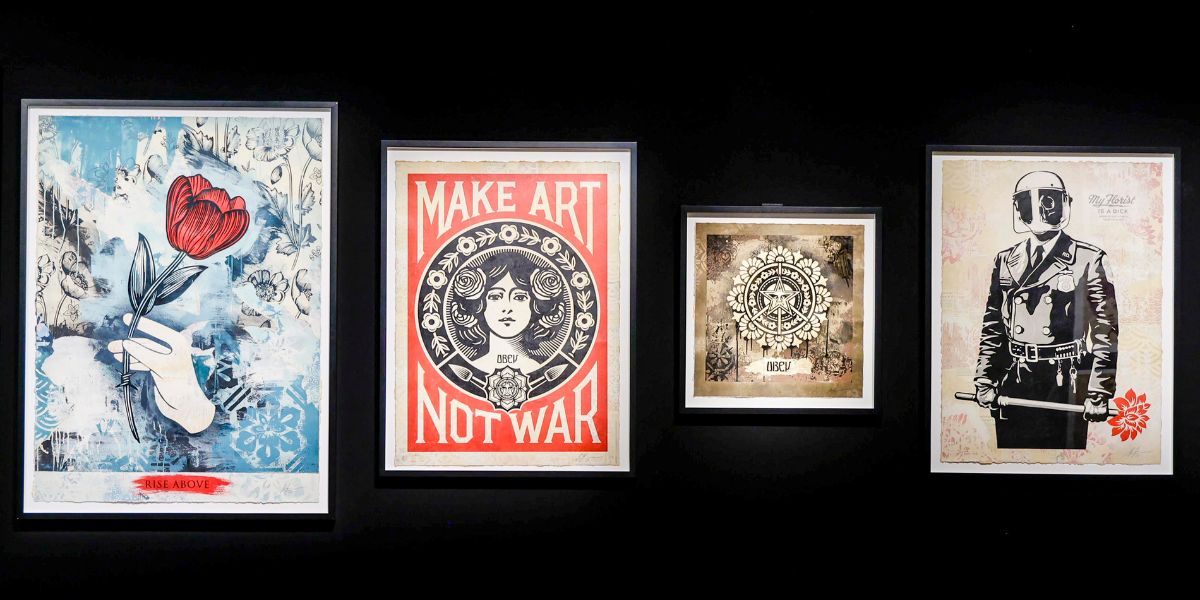
For Shepard Fairey, peace is never a neutral image or a passive condition. In OBEY’s visual language, it does not coincide with the simple absence of conflict or with an abstract ideal, but becomes a stance: a practice that requires awareness, responsibility and the ability to imagine alternative forms of coexistence.
His work stems from a critical observation of the contemporary world: wars, inequalities, environmental crises and social tensions become the starting point for a broader reflection on the role of the individual within the collective. In this scenario, peace is linked to concepts such as participation, solidarity and shared responsibility: an active choice that calls individuals and communities to contribute to building a more equal and inclusive society.
A Universal Visual Language
One of the most significant aspects of OBEY’s research is its ability to translate complex concepts into immediately readable images.
Over the years, the artist has developed a visual vocabulary made up of recurring symbols: the peace sign, flowers, doves, ornamental motifs, radial compositions and monumental figures that characterize much of his production. Although these elements recall the graphic language of political and advertising propaganda, they are used to promote messages of dialogue, cooperation and social change.
The strength of these images lies precisely in their accessibility. Fairey uses familiar visual codes to attract public attention and transform urban space into a place of reflection. Peace thus becomes not only a theme, but also a shareable and immediate visual message, capable of reaching people from different cultural contexts.
Beyond Denunciation
Although many of OBEY’s works address themes related to war, propaganda or imbalances of power, his work never ends with critique.
Fairey uses art to highlight real issues, while at the same time suggesting the possibility of imagining alternatives. In this sense, peace represents a perspective through which to reread the present and build new forms of coexistence.
This vision is effectively embodied in the expression Power to the Peaceful, a declaration that summarizes the belief that change can arise from collective action, participation and people’s ability to organize around shared values.
Peace in OBEY: Power to the Peaceful
The centrality of this theme clearly emerges in the solo exhibition OBEY: Power to the Peaceful, hosted at Gallerie d’Italia in Naples.
Within the exhibition path, the section Guerra e Pace explores the relationship between conflict, power and collective action. The works gathered in this section reflect on violence in its most evident forms, but also in its more subtle manifestations, showing how it can infiltrate language, media and everyday dynamics.
From this perspective, peace is not presented as a static condition, but as an active process built through awareness, memory and participation. The images invite the public to question their own role within society and the possibility of contributing to collective transformation.
In the same way, the mural Third Eye Open Peace, created by Shepard Fairey in the Ponticelli district of Naples, is part of this reflection. Through recurring symbols from his imagery — the peace sign, floral elements and the third eye — the work proposes an idea of peace linked not only to the relationship with others, but also to the ability to develop awareness of oneself and the world around us.
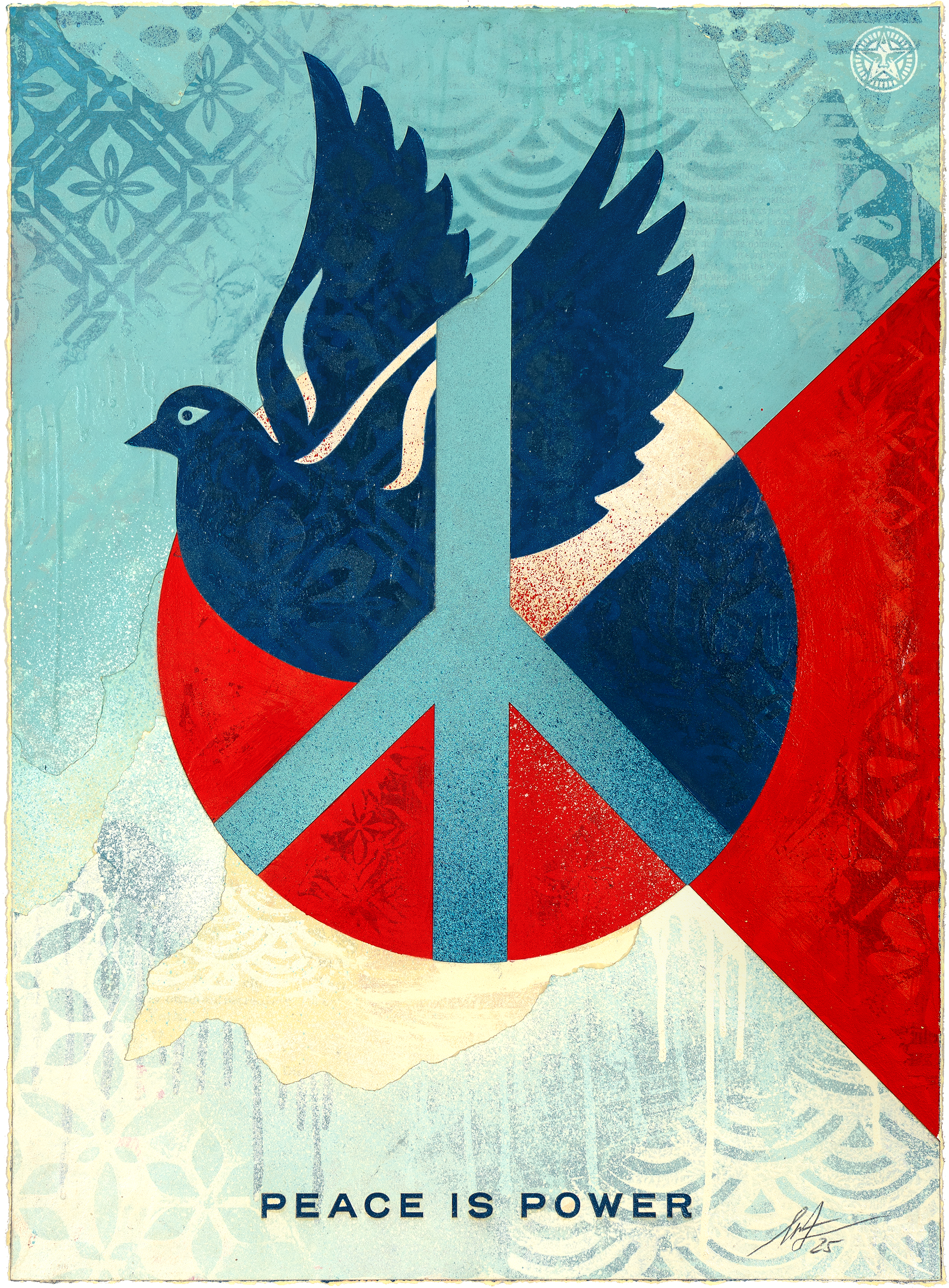
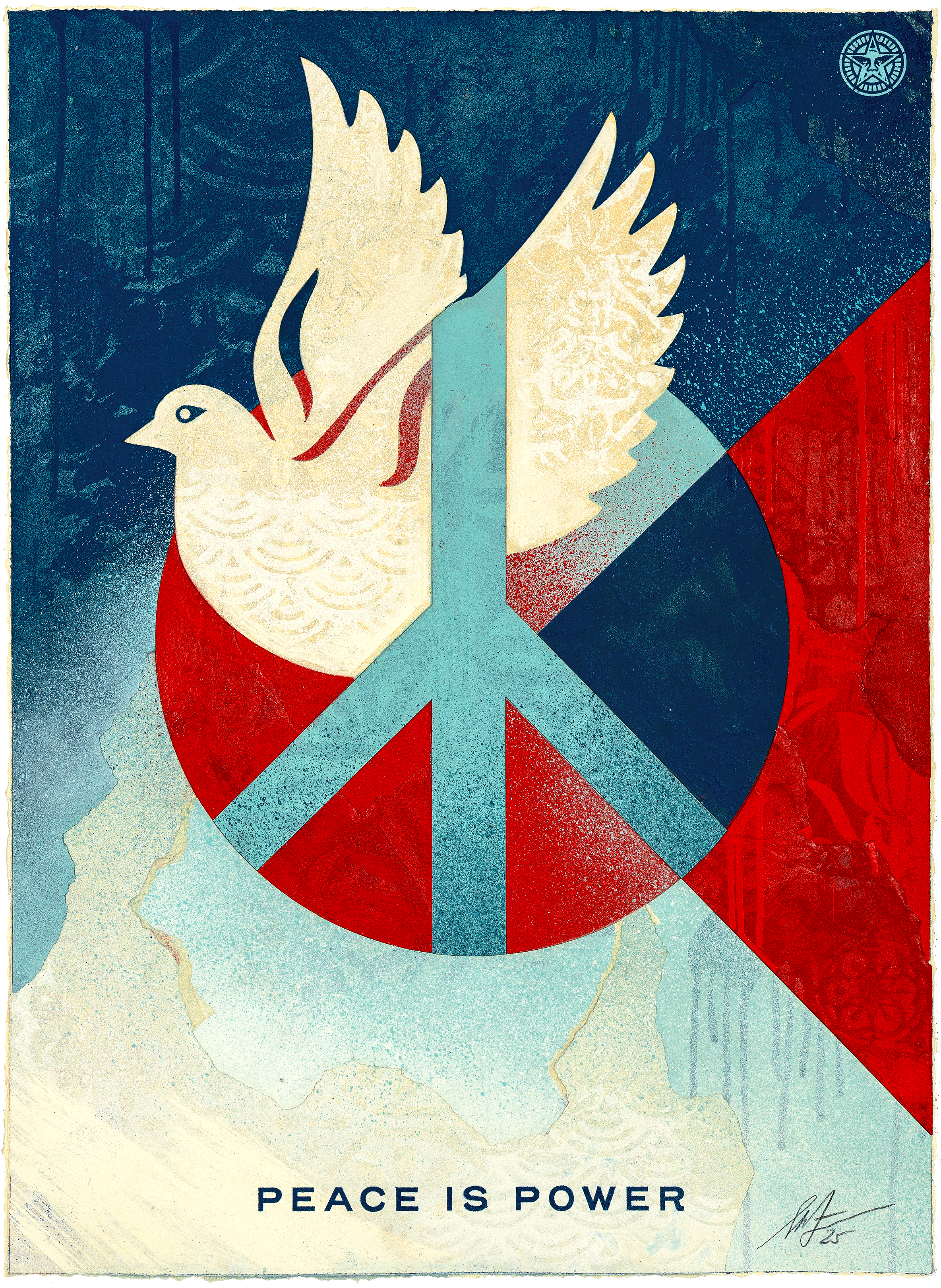
Peace is Power, the intervention created on the stairs of the Chiesa Nuova within the Donnaregina complex, also belongs to this same direction. Here, OBEY’s pacifist message enters into dialogue with a historic and public space of the city, transforming peace into a shared and accessible image.
A Theme Running Through His Entire Research
In Shepard Fairey’s production, peace is a transversal theme, returning whenever the artist addresses issues related to human rights, social justice, the environment and democratic participation.
More than a specific subject, peace becomes a key to reading his work: a perspective from which to observe the relationship between art, society and collective responsibility. In this vision, the image is not only an expressive medium, but a tool capable of activating dialogue, critical thinking and shared imaginaries.
This is also why OBEY’s message continues to remain relevant: because it interprets peace not as an abstract ideal to be represented, but as a common responsibility to be built through choices, images and collective actions.