
 Register


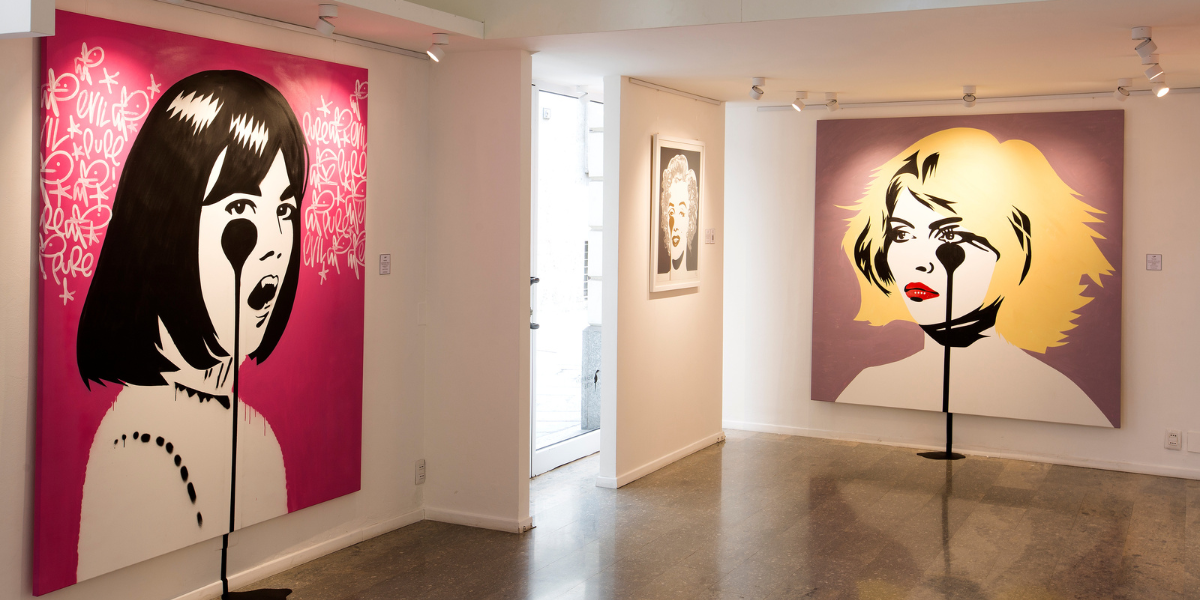
Not my circus, not my monkeys explores the research of Charles Uzzell Edwards, aka Pure Evil, the British artist who has developed a visual language suspended between pop culture, media imagery, and contemporary urban sensibility. The project brings together works on paper, canvas, and Perspex connected to the celebrated Nightmare series, in which iconic faces from cinema, music, and popular culture are reinterpreted through an essential and immediately recognizable visual language.
Nightmare and the Culture of the Image
The Nightmare series takes shape from the visual imagery of the 1960s, a period marked by the expansion of celebrity culture and the spread of American and European Pop Art. Actresses such as Marilyn Monroe, Elizabeth Taylor, Natalie Wood, and Sharon Tate become central figures in a reflection on the relationship between public image, desire, and fragility.
Pure Evil reworks this iconographic universe through portraits characterized by features reduced to their essentials and by a dark tear, a recurring element that transforms the image of the celebrity into a symbol of vulnerability and disillusionment.
As the artist states:
“The eyes drip deep painted tears and represent broken dreams of love.”
Pop Art, Reproduction, and Collective Imagery
Pure Evil’s research also stems from a reflection on the reproducibility of the image and the transformation of icons within contemporary culture. The influence of Pop Art, particularly Andy Warhol’s practice, runs throughout the entire project, questioning the relationship between originality, seriality, and visual consumption.
The artist thus develops a language that fuses pop aesthetics and urban sensibility, reinterpreting figures belonging to collective memory through stencils, spray paint, and simplified compositions that retain a strong emotional dimension.
Celebrity, Melancholy, and Disillusionment
Although it begins with the universe of celebrity culture, Nightmare does not construct a celebration of the public image. Instead, the figures depicted appear suspended in a melancholic dimension, where success, desire, and vulnerability coexist.
The tear becomes the visual sign that runs through the entire series: a simple yet symbolically powerful element, capable of condensing emotional tensions, personal fragilities, and the contradictions of the contemporary imaginary.
Between Street Art and Contemporary Culture
Throughout his research, Pure Evil develops a language that connects Street Art, pop culture, and a critique of the contemporary image. In this context, Not my circus, not my monkeys takes shape as a reflection on the way images circulate, are consumed, and continue to influence the construction of the collective imaginary.