
Sticker as visual language: from the street to the urban imaginary
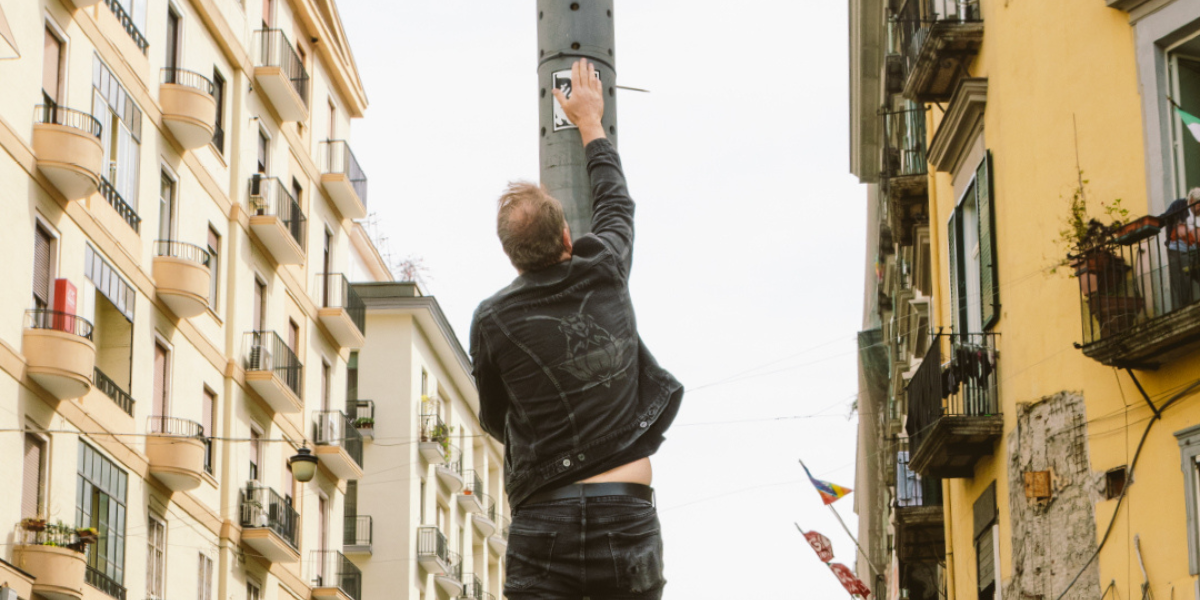
Small, fast, repeatable: the sticker is one of the most direct ways for an image to enter urban space. It does not have the monumental scale of a mural or the permanence of a public artwork, but it has a different kind of power: that of sudden appearance and repetition.
In urban culture, the sticker works as a quick signal. It is a signature, a fragment of visual identity, an image that enters the everyday landscape without asking permission and without requiring major resources. Its effectiveness lies in its ability to condense everything into just a few elements: a face, a word, a symbol, a graphic contrast.
More than uniqueness, the sticker values circulation. A single sticker may go unnoticed, but many stickers, repeated in different parts of the city, build presence, recognition, and familiarity. It is precisely this logic of repetition that has made the sticker one of the most effective tools in street culture.
OBEY: when a sticker becomes an icon
One of the most emblematic examples is Shepard Fairey’s “Andre the Giant Has a Posse” campaign, launched in 1989 when the artist, then a student at the Rhode Island School of Design, created a sticker featuring the face of wrestler André the Giant. The image emerged almost spontaneously, within a context connected to skate culture and underground graphics, but it quickly spread far beyond its original environment.
The strength of the sticker also lay in its ambiguity. André’s face did not clearly point to a specific meaning; it simply appeared in urban space, always the same and always out of place, generating curiosity. Fairey himself described the project as an experiment linked to phenomenology: a way to reawaken people’s attention to the images they encounter every day.
In an urban landscape dominated by logos, advertising, and commercial messages, that sticker used the same mechanisms as mass communication — repetition, recognizability, dissemination — but shifted them into a freer and more unpredictable territory.
From André the Giant’s face to OBEY
Over time, “Andre the Giant Has a Posse” evolved into the OBEY project. The image was simplified, made more graphic, more frontal, and increasingly close to an icon. The word “OBEY” itself, dry and authoritarian, also helped build an imagery that evokes propaganda, political posters, pop graphics, and urban culture.
The success of OBEY shows how a sticker can become much more than a street intervention. From an informally circulated adhesive, André’s face became a global symbol, able to move across works in different media and formats, clothing, and exhibitions. Starting from a minimal gesture, it turned into a recognizable, shared, and replicable language.
Sticker culture: diffusion, identity, belonging
The OBEY case is central, but not isolated. Stickers have always been part of street culture because they perfectly respond to its logic: they occupy space quickly, travel easily, and can be exchanged, collected, applied, removed, and preserved. They are images designed to move.
For many artists, the sticker was an early tool for diffusion, a way to test an image in urban space and make it recognizable. A large-scale intervention is not always necessary: a repeated sign in the right place can be enough. In this sense, the sticker works as a small visual unit capable of building identity.
The sticker as a shared practice
OBEY is one of the best-known examples, but the sticker does not belong to a single story. It runs through street culture as a simple and versatile format, capable of adapting to very different visual worlds.
This is the case with D*Face, who in the early stages of his career filled the streets of London with self-produced stickers, gradually building an immediately identifiable visual universe. Before the large murals, it was precisely stickers that allowed him to spread his language, made up of references to punk aesthetics, skate culture, and advertising. The sticker thus became a tool for visibility and experimentation, a kind of urban signature that anticipated many of the elements that would later define his work.
In the case of Invader, too, although in a different way, the sticker fits perfectly into the logic of the artistic project. His famous pixelated figures, scattered across cities around the world as part of a true “invasion,” find a natural extension in stickers: light, easily transportable, collectible images that allow the project to continue circulating even outside urban space. It is no coincidence that Invader has often produced sticker packs inspired by his mosaics, transforming some of his most iconic works into objects to preserve, exchange, and spread.
In 2021, the artist also collaborated with PETA France, an organization that defends animal rights, creating a series of limited-edition stickers and T-shirts with slogans such as “Freedom for All” and “We Come in Peace, We Don’t Eat Flesh!”. The collection sold out in less than three hours, once again confirming the communicative power of this format. At the same time, the campaign was also spread through the urban space of Paris, showing how the sticker continues to be an effective tool for making images and messages travel far beyond the traditional boundaries of art.
From André’s face to D*Face’s pop stickers and Invader’s pixelated icons, the same idea emerges: the sticker may be small, but it is far from marginal. It is an agile, immediate tool deeply connected to urban culture, capable of transforming an image into a presence and simple repetition into a shared visual phenomenon.