
Obey, Naples and Art in Public Space: A Plaque for Shepard Fairey
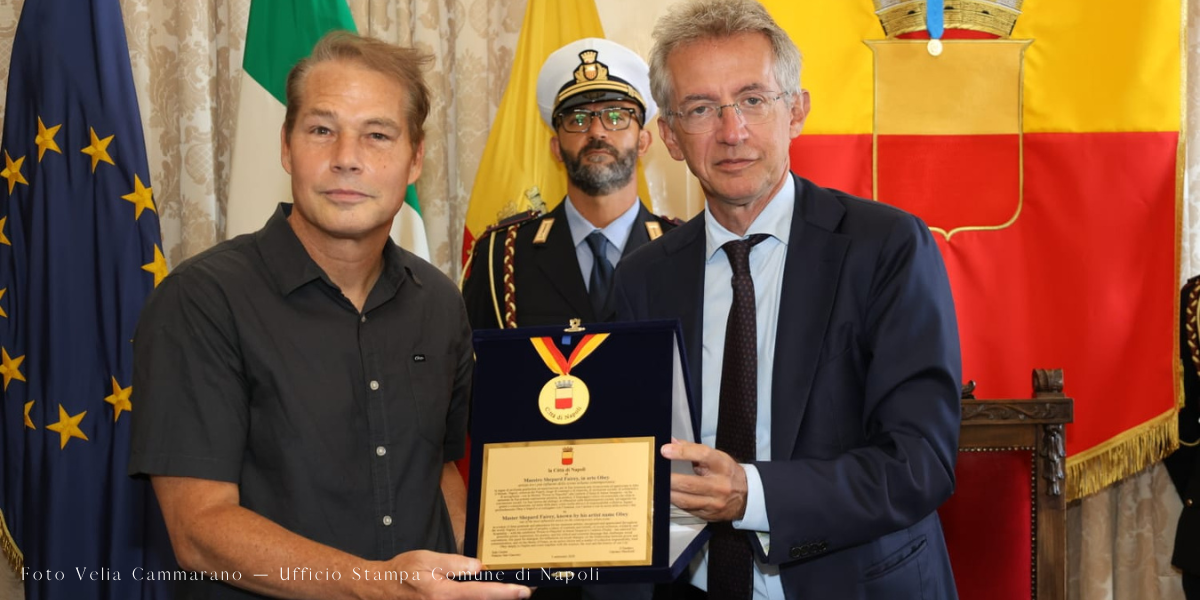
In Naples, art is not simply something to look at. It enters the streets, engages with the city, confronts memory and, above all, takes a position.
It is also for this reason that the City of Naples has chosen to present a plaque to Shepard Fairey, known as Obey, one of the most recognizable and influential artists on the international urban art scene. The recognition was presented today, September 3, by Mayor Gaetano Manfredi in the Council Chamber of Palazzo San Giacomo, as a sign of appreciation for the relationship the artist has built with the city and for the civic value of his work.
When Street Art Becomes a Civic Language
Obey's journey began in the late 1980s with the Obey Giant campaign, a project that would gradually transform an image and an aesthetic into a genuine system of visual communication.
Over the years, Fairey has brought the language of the street into galleries, museums and public spaces, while maintaining one fundamental characteristic: the desire to speak to a broad audience, beyond the traditional boundaries of contemporary art.
Social justice, peace, propaganda, power and collective responsibility are among the themes that run through his work. It is a production in which posters, graphic design, photography and popular culture come together to create immediate, often monumental images, designed to raise a question before offering an answer.
His international reputation is also closely linked to the celebrated “Hope”, the portrait of Barack Obama created in 2008 during the United States presidential campaign. An image that quickly became one of the icons of contemporary political communication.
Naples as a City in Motion
The relationship between Obey and Naples seems to find particularly fertile ground in the very nature of the city.
Naples is a layered city, where the past never stops engaging with the present and where public imagery has always been part of everyday life. Churches, monuments, murals, posters, spontaneous signs and popular culture coexist within an urban space where art can hardly remain confined.
It is therefore no surprise that the exhibition “Power to Peaceful”, hosted at the Gallerie d'Italia of Intesa Sanpaolo on Via Toledo, has found a particular resonance here.
More than 130 works by Obey are presented in the exhibition, exploring themes of peace, social justice, propaganda and the dynamics of power. The exhibition is open until September 6, 2026.
But the relationship with Naples does not end within the exhibition halls.
Art Beyond the Museum
Perhaps this is the most interesting aspect of the recognition granted by the city: the awareness that Obey's work belongs to an idea of art capable of moving beyond institutional spaces.
In his remarks, Shepard Fairey emphasized the value of art in public space: a culture not intended exclusively for an elite, but accessible and shared.
This position echoes the original nature of street art, which also emerged as a way of intervening directly in the urban landscape and in shared public space.
And Naples, in this sense, is not a neutral backdrop. It is part of the work.
The city has welcomed Obey's work by placing it in dialogue with an already powerful visual tradition. A tradition made up of symbols, images, devotion, politics, music, football and memory. The artist himself has described feeling a particular connection with a territory capable of constantly bringing the past and the future into conversation.
A Recognition That Also Speaks About the City
For Mayor Gaetano Manfredi, the plaque is a way of consolidating over time a relationship that began around the exhibition and the artist's interventions in Naples. The city views Obey's work as a form of civic engagement and an invitation to participation, elements considered particularly close to the democratic spirit of Naples.
The meaning of the recognition, therefore, goes beyond celebrating an international artist.
It is also a statement about the role Naples wants to give contemporary art: not simply decoration, but a tool for questioning society, occupying public space and creating new forms of dialogue.
Ultimately, this is where Obey's poetics meet Naples.
In the idea that an image can still stop us in our tracks, open a discussion and transform, even if only for a moment, the way we look at the place in which we live.
And in a city like Naples, where every wall seems to have something to say, that is no small thing.